



Companies are collecting more and more data, but its availability alone does not guarantee accurate business decisions. Fabric IQ is designed to help organizations better understand their data by providing the business context necessary for analysis, reporting, and the use of artificial intelligence.
A brief introduction to Microsoft IQ and the role of Fabric IQ in the ecosystem
Microsoft is developing the concept of Microsoft IQ, whose goal is to provide both artificial intelligence systems and business users with a deeper understanding of the organization. In this approach, data is no longer treated merely as records in tables, but as elements describing real business processes.
Fabric IQ is responsible for the data and business analytics layer. It leverages information stored in the Microsoft Fabric environment to build a shared context for reports, analytics, and AI solutions. As a result, the organization can operate with a single, consistent business language regardless of the tools used.
What is Fabric IQ?
Fabric IQ is a new capability within the Microsoft Fabric ecosystem, designed to connect enterprise data with its business meaning. The solution uses semantic models, ontologies, and data stored in OneLake to create a shared context for users, reports, and AI agents.
This allows organizations to move from simple data storage to building business knowledge that supports decision-making and process automation.
The role of Fabric IQ in the Microsoft IQ ecosystem
Within the Microsoft IQ concept, Fabric IQ is responsible for business and analytical data. Its role is to provide insights into the state of the enterprise based on historical, operational, and real-time data.
Fabric IQ leverages existing Microsoft Fabric components such as:
- OneLake
- Power BI semantic models
- Business ontologies
- AI-supporting solutions
Thanks to this, all analytics, reports, and AI agents rely on the same business definitions and data sources.
How does Fabric IQ transform data into business knowledge?
Instead of analyzing individual sales records, organizations can define business concepts such as:
- customer
- order
- delivery
- product
- customer service level
These concepts are then used across reports, AI models, and business processes. This enables faster identification of relationships, detection of anomalies, and more informed decision-making based on a shared understanding of data.
The difference between storing data and understanding its meaning
Data storage answers the question: “What information do we have?”
Understanding data answers questions such as:
- What does this information mean for the business?
- What relationships exist between different objects?
- What actions should be taken based on this data?
This is why Microsoft is developing the Fabric IQ concept. Thanks to the semantic layer, organizations can define business concepts once and reuse them in Power BI reports, analytical processes, and AI-driven solutions.
This approach creates a more consistent data environment, increases trust in reports, and enables more effective use of AI across the enterprise.
What are the components of Fabric IQ?
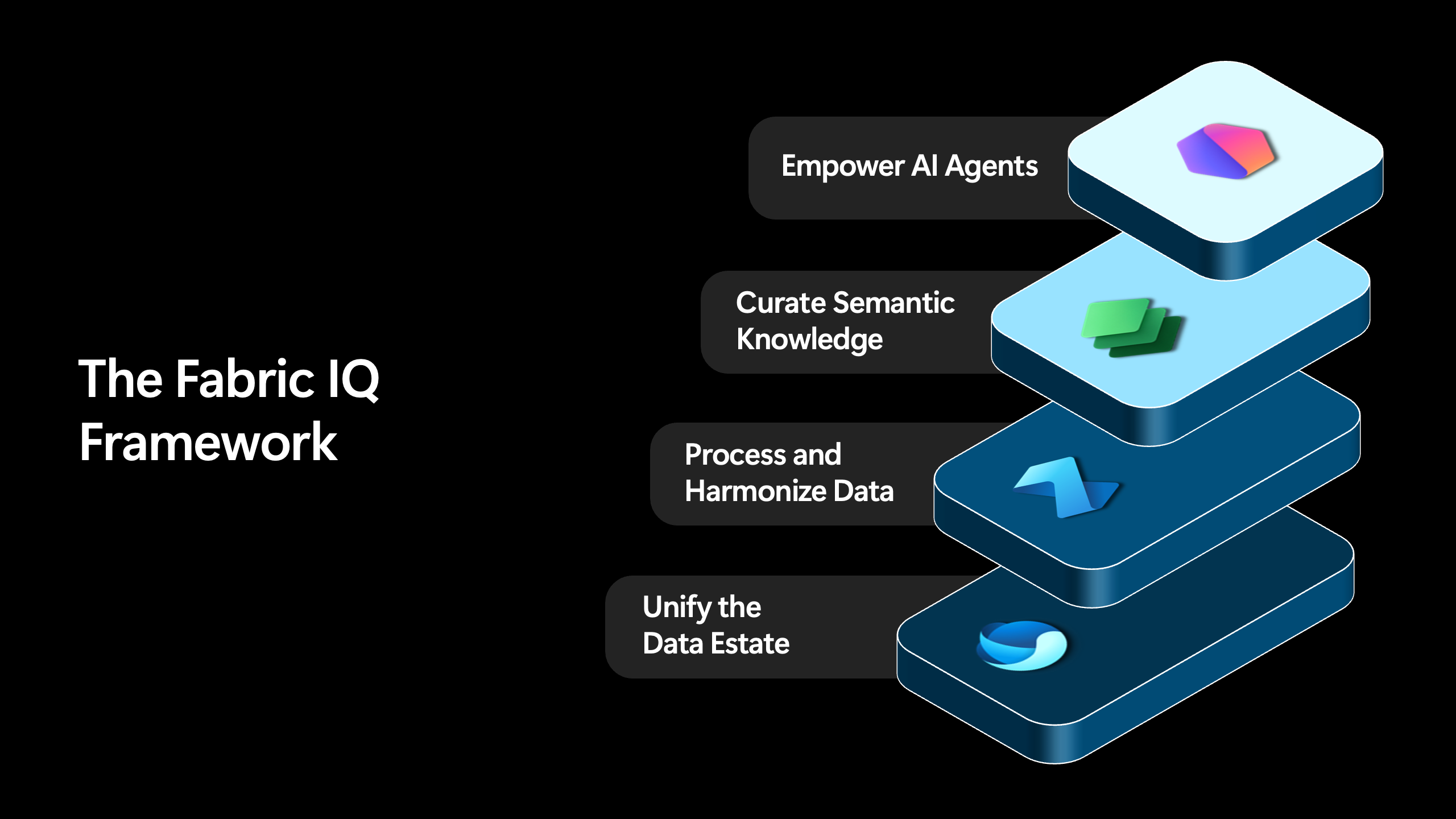
Fabric IQ is built on a set of components that together create a business context layer for data, reports, and AI solutions. Their role is not only to store data but also to assign business meaning and ensure consistent interpretation across the organization.
The key elements of Fabric IQ include:
- OneLake as the central data source
- Power BI semantic models
- Business ontologies
- Graph
- Data Agents and Operations Agents
- Plan
Together, these components create an environment where data, analytics, and AI share the same business definitions.
OneLake as the data foundation
The foundation of Fabric IQ is OneLake, the data storage layer within Microsoft Fabric. It unifies data from multiple sources and makes it available in a single, centralized location.
OneLake also acts as the data distribution layer, providing consistent access for reports, semantic models, ontologies, and AI agents.
Power BI semantic models
An important component of Fabric IQ is Power BI semantic models, which provide an organized analytical layer.
Within semantic models, the following are defined:
- business measures
- KPIs
- data hierarchies
- relationships between objects
This ensures that business users rely on the same definitions regardless of the report or dashboard. Importantly, ontologies in Fabric IQ can be generated directly from existing Power BI semantic models, maintaining a consistent business language across the organization.
Business ontologies
One of the most critical elements of Fabric IQ is business ontologies. Their purpose is to define the concepts used within the organization and the relationships between them.
An ontology may describe:
- customers
- orders
- deliveries
- products
- enterprise resources
This ensures that both business users and AI solutions use the same vocabulary, reducing misinterpretation and ensuring consistency across departments.
Graph – business relationship analysis
The Graph component enables storing and analyzing relationships between business objects.
Unlike traditional data structures, Graph allows tracking relationships across business processes. For example, an organization can analyze connections between an order, shipment, transport monitoring sensors, and potential incidents affecting delivery quality.
This approach supports impact analysis and helps identify root causes of operational issues.
Data Agents and Operations Agents
Data Agents and Operations Agents leverage the knowledge stored in Fabric IQ within AI-driven solutions.
- Data Agents allow users to ask questions in natural language and generate answers based on semantic models and ontologies.
- Operations Agents focus on monitoring operational data in real time, detecting anomalies, identifying potential issues, and recommending actions.
This enables organizations to use AI more effectively for analysis and decision-making.
Plan – planning and forecasting
Plan is a Fabric IQ component that supports planning, forecasting, and reporting processes based on a shared data foundation.
It enables integration of planning processes with Power BI semantic models. Organizations can compare business assumptions with actual performance and respond more quickly to changing market conditions.
Combining planning and analytics in a single environment reduces the need for multiple disconnected tools.
How does OneLake eliminate data silos?
One of the biggest challenges modern organizations face is data being stored across multiple independent systems—ERP, financial applications, data warehouses, cloud solutions, and on-premises databases.
OneLake is designed to reduce this fragmentation and create a unified data environment.
Integration of on-premises and cloud data
OneLake supports data from both on-premises and cloud environments.
This means organizations do not need to build separate repositories for different systems. All data can be accessed within a single analytics platform, simplifying data management.
Shortcuts and Mirroring
Microsoft Fabric uses Shortcuts and Mirroring mechanisms to integrate data without duplicating it.
- Shortcuts allow OneLake to reference data stored in other locations
- Mirroring synchronizes data across environments
This reduces integration complexity and accelerates data access.
Data centralization in Microsoft Fabric
OneLake acts as a central data repository for the entire Microsoft Fabric environment.
The same data is used by:
- Power BI reports
- semantic models
- business ontologies
- Data Agents
- Operations Agents
As a result, all analytics and AI solutions are based on consistent, trusted data.
Business benefits of unified data
Reporting consistency
A unified data environment reduces discrepancies between reports created by different teams. All analytics rely on the same data sources and business definitions.
Easier access to information
Centralized data simplifies searching and analysis. Business users no longer need multiple tools and databases to get a complete picture.
Reduced data duplication
Using OneLake and Microsoft Fabric integration mechanisms reduces unnecessary data copying.
This results in better data control, easier management of the analytics environment, and lower risk of inconsistencies in reports and business analyses.
Summary
Fabric IQ demonstrates the direction in which modern analytics platforms are evolving. Traditional Business Intelligence focused mainly on collecting data and creating reports.
Today, organizations expect more – a consistent environment that not only presents information but also helps interpret and use it for decision-making.
Planning a Microsoft Fabric implementation?
Learn how to build a unified data, reporting, and AI environment in your organization. EBIS experts can help you design an architecture based on Microsoft Fabric, Power BI, and modern analytics solutions tailored to your business needs.