



Is your organization fully leveraging the potential of its data?
In many companies, information is available in ERP systems, CRM platforms, financial tools, or marketing applications. The problem is rarely the lack of data – more often, the challenge is quickly extracting the right insights and using them in everyday business decisions.
The development of artificial intelligence is significantly changing the way we work with data. Microsoft Fabric introduces a new approach, where users can leverage AI not only to analyze information but also to actively use it in business processes. Two key solutions play a central role here: Data Agent and AI Agents.
Although their names are similar, they serve different functions and address different organizational needs.
Data Agent vs AI Agents – key difference
In simple terms:
- Data Agent is responsible for data analysis and user interaction
- AI Agents extend these capabilities with action automation and process execution
Data Agent acts as an intelligent analytical assistant – it answers questions and helps understand data. AI Agents go one step further – they can use data to take actions and execute complex scenarios.
How does Data Agent work in Microsoft Fabric?
Data Agent is a solution that changes how organizations use data. Instead of searching reports or building queries, users can ask questions in natural language.
For example:
- What does sales look like by region?
- Which products generate the highest margin?
- How have financial results changed in the last quarter?
Data Agent: - interprets the user’s question,
- identifies relevant data,
- generates queries (e.g., SQL or DAX),
- presents results in a clear format.
This makes data analysis accessible not only to analysts but also to business users.
What does this mean in practice?
- no need to know BI tools
- faster access to answers
- greater data accessibility within the organization
Data Agent therefore acts as a “translator” between the user and the data.
AI Agents – more than data analysis
AI Agents in Microsoft Fabric represent a broader approach to using artificial intelligence. They are not limited to answering questions – they can execute specific tasks and support business processes.
AI Agent can:
- analyze data in the context of a specific goal,
- generate recommendations,
- detect anomalies and trends,
- perform multi-step actions,
- integrate with various components of the environment (e.g., pipelines, models, APIs).
In practice, this means an AI Agent not only “responds” but also “acts.”
Example
- Data Agent: “Sales in region X decreased by 15%”
- AI Agent: → identifies the decrease → analyzes possible causes → generates recommendations → can trigger follow-up actions (e.g., alert, workflow, detailed analysis)
How do Data Agent and AI Agents work together?
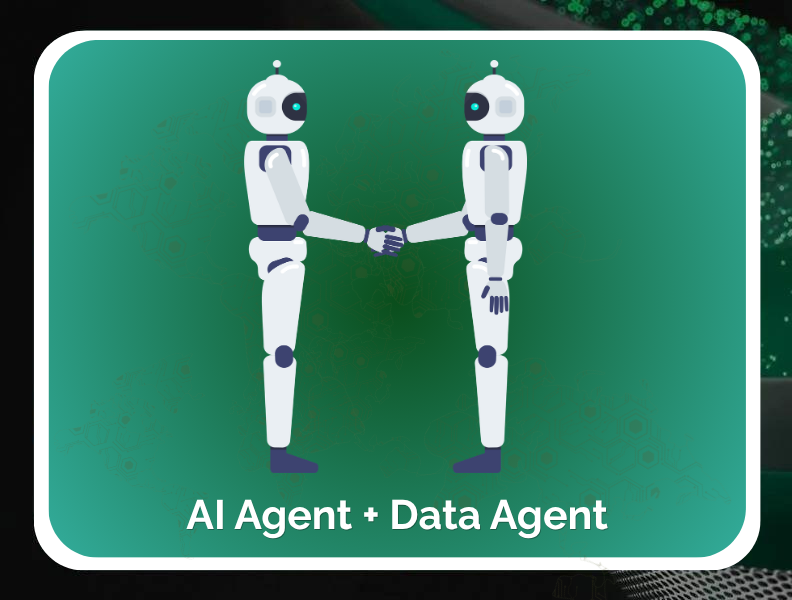
These two solutions do not compete – quite the opposite, they complement each other.
- Data Agent provides quick access to information
- AI Agents use that information to execute actions
This can be compared to two levels of data usage: - Understanding – what is happening in the data (Data Agent)
- Action – what should be done about it (AI Agents)
This approach allows organizations to move from passive data analysis to active information management.
Business benefits
Faster access to information
Users can get answers to their questions within seconds, without involving BI teams.
Data democratization
Every business employee can analyze data without technical knowledge.
Process automation
AI Agents eliminate repetitive tasks and support analytical processes.
Better decisions
With up-to-date data and recommendations, organizations can respond more quickly to changes.
From analysis to action
The greatest value lies in using data not only for reporting but for real business impact.
How to use Microsoft Fabric in your organization?
To fully leverage the potential of Data Agent and AI Agents, the following are key:
- data organization and integration (e.g., Lakehouse, Warehouse)
- building semantic models
- implementing a modern reporting layer (Power BI)
- identifying processes that can be automated
At EBIS, we help organizations: - design and implement Microsoft Fabric environments
- integrate data from multiple sources
- build modern analytical solutions
- deploy AI in business processes
- train business and technical teams
Summary
Microsoft Fabric introduces a new way of working with data, where artificial intelligence plays a key role.
Data Agent enables quick understanding of data and answering business questions. AI Agents extend these capabilities, allowing organizations to automate processes and take action based on analysis.
Combining these two approaches enables a shift from traditional Business Intelligence to intelligent, dynamic analytics that supports real business decisions.