




As the number of data sources grows and expectations around reporting increase, organizations are increasingly facing the challenge of ensuring consistency and reliability of management information. Data coming from ERP systems, finance and accounting platforms, operational tools, or Excel spreadsheets often exists in isolation, making it difficult to deliver unified business analytics.
In this context, data warehouse in Fabric serves as the central point of the data architecture, organizing information, standardizing business definitions, and enabling efficient reporting in Power BI. Microsoft Fabric integrates data ingestion, transformation, modeling, and analysis within a single environment, significantly shortening the path from source data to business decisions.
A well-designed data warehouse in Microsoft Fabric is not just a technical backend for reports. It is the foundation of analytics that allows organizations to scale reporting, develop KPIs, and ensure a single source of truth across the entire company.
What is a data warehouse in Microsoft Fabric
A data warehouse in Microsoft Fabric is a logically structured data repository designed for business analytics, reporting, and working with large volumes of data coming from multiple source systems. Unlike point solutions, Fabric provides a consistent environment covering the entire data lifecycle—from ingestion and transformation to presentation in Power BI.
In practice, a data warehouse in Fabric enables:
- consolidation of data from various business systems,
- standardization of metric and KPI definitions,
- preparation of data in a structure optimized for analytics.
As a result, the data warehouse becomes the foundation of consistent analysis rather than merely a technical backend for individual reports.
The role of the data warehouse in the Microsoft Fabric ecosystem
Microsoft Fabric was designed as an integrated analytics platform in which the data warehouse plays a key role in the analytics layer. It is closely connected with other platform components such as OneLake, data integration tools, and Power BI semantic models.
Within the Fabric ecosystem, the data warehouse:
- uses the shared OneLake data layer,
- works alongside lakehouses and ETL/ELT processes,
- feeds Power BI reports and dashboards with consistent business data.
This approach allows BI teams to work within a single environment, without the need to maintain multiple separate tools and data silos.
Differences between a data warehouse, lakehouse, and traditional data warehouse
Although the terms data warehouse and lakehouse are sometimes used interchangeably, in Microsoft Fabric they serve different purposes:
Data warehouse in Fabric:
- data is structured and prepared for reporting,
- emphasis is placed on metric consistency and query performance,
- an optimal choice for management and operational reporting.
Lakehouse:
- flexible storage of raw and semi-structured data,
- greater analytical freedom at the cost of standardization,
- commonly used by data science and advanced analytics teams.
Traditional data warehouse:
- usually requires separate tools for data integration and reporting,
- less flexible in terms of expansion,
- higher maintenance costs and longer implementation timelines.
Microsoft Fabric makes it possible to combine these approaches within a single platform while maintaining a clear separation of responsibilities across data layers.
Data warehouse architecture in Fabric
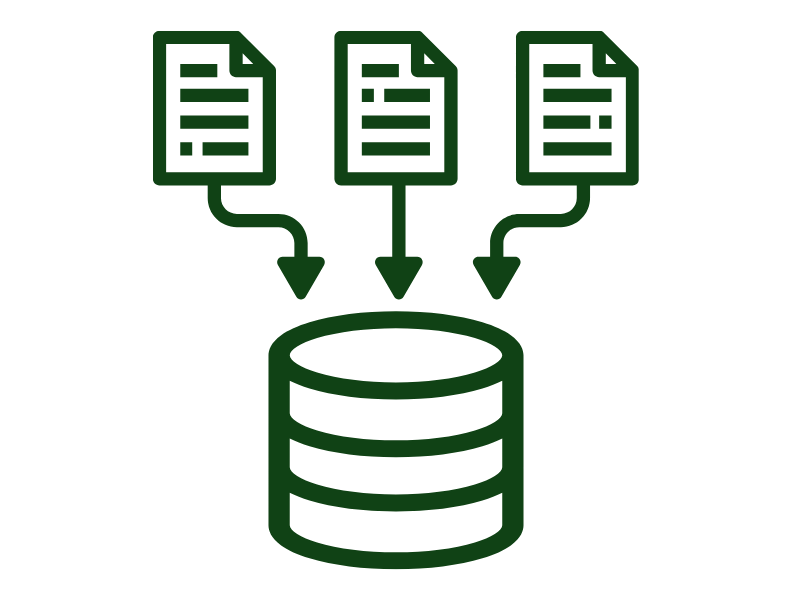
The central element of the Microsoft Fabric architecture is OneLake, a unified data storage layer used by all platform components. The data warehouse in Fabric uses OneLake as a shared repository, eliminating the need to duplicate data across systems.
Thanks to OneLake:
- data is accessible to multiple teams and tools,
- consistent access control can be applied,
- the data architecture remains transparent and scalable.
This significantly simplifies data management in organizations working with multiple data sources and analytical use cases.
Integration with diverse data sources
A data warehouse in Fabric is designed to integrate data from a wide range of business systems, including:
ERP and financial systems
- sales, cost, and budget data,
- chart of accounts, cost centers, accounting periods,
- consistent financial and controlling reporting.
Operational systems and business applications
- project, logistics, and production data,
- information on processes and operational efficiency,
- the ability to combine operational and financial data.
Excel files and external data
- spreadsheets used by business departments,
- market data, benchmarks, and external system data,
- elimination of manual data merging in reports.
Data warehouse architecture layers in Fabric
The data warehouse architecture in Fabric is based on a logical separation into layers, which simplifies solution development and maintenance:
Data ingestion
Automated and controlled extraction of data from source systems.
Transformation and modeling
Data cleansing, structure standardization, and building data models aligned with business logic.
Analytics layer
Data prepared for reporting in Power BI, optimized for performance and end-user needs.
This layered approach ensures architectural clarity and enables analytics to scale as the organization grows.
The role of the data warehouse in Power BI reporting and analytics
The data warehouse in Fabric serves as a stable and high-performance data source for Power BI reports. By pre-organizing, processing, and structuring the data, reports no longer need to perform complex calculations in real time, which significantly improves performance.
In practice, this means:
- shorter report refresh times,
- faster visualization response to user interactions,
- reduced load on data sources and report models.
Power BI, powered by data from a well-designed data warehouse in Fabric, becomes an analytical tool ready for both operational and management-level use.
Semantic models and their importance for business users
A key element connecting the data warehouse in Fabric with Power BI is semantic models. They translate the technical structure of data into language understandable by business users.
With semantic models:
- users work with consistent definitions of KPIs and metrics,
- reports are clear and intuitive,
- business teams can analyze data independently without IT intervention.
The data warehouse provides structured data, while the semantic model gives it business context, which is crucial for the effective use of Power BI within the organization.
Scalability and performance for large data volumes
As the volume of data and the number of report users grow, scalability becomes increasingly important. The data warehouse in Microsoft Fabric is designed to handle large volumes of data without compromising analytical performance.
Benefits include:
- support for a growing number of reports and dashboards,
- the ability to analyze both historical and current data,
- stable performance even with a large number of concurrent users.
This is particularly important for organizations where Power BI serves as a central reporting tool for multiple departments.
Why implement a data warehouse in Fabric with a BI partner
Implementing a data warehouse in Fabric is not just about technology configuration—it is primarily about designing a data architecture aligned with real business needs. A BI partner’s experience helps avoid errors that may only appear during report development or solution scaling.
A BI partner:
- selects the appropriate data model,
- plans the architecture with future needs in mind,
- ensures data consistency and analytical performance.
Combining technical and business expertise
An effective data warehouse is never built in isolation from the business context. A BI partner combines technical knowledge with an understanding of organizational processes, allowing data to translate into tangible analytical value.
This approach enables:
- accurate mapping of business processes in the data model,
- creation of reports that support decisions rather than just display numbers,
- better adoption of Power BI by end-users.
The partner’s role in maintaining and further developing the solution
A data warehouse in Fabric is a long-term solution that evolves with the organization. A BI partner supports not only the implementation but also:
- the development of new data sources,
- performance optimization,
- adaptation of the architecture to changing business needs.
As a result, the data warehouse remains current and valuable over the long term.